
Logic Grid Puzzles: Brain Game
Egghead Games LLCWord
4.7217.00 Reviews
- Version
- 5.7.4
- Installs
- 100.00K
- Age Rating
- Everyone
Screenshots
Our Review of Logic Grid Puzzles: Brain Game
 Analysis by Appyee
I enjoy word games that make me slow down and think rather than simply tap through a timer, and Logic Grid Puzzles: Brain Game fits that preference well. It is a free puzzle game from Egghead Games LLC built around deduction: you read clues, connect people or objects with possible answers, and gradually eliminate combinations until one solution remains. That sounds simple, but a well-designed grid can keep me focused for quite a while.
After spending time with it, I see the game as a quiet brain-training option rather than a fast arcade distraction. It suits a coffee break, a commute, or an evening when I want something mentally active without sound, competition, or a complicated story. The central appeal is the feeling of turning a messy set of clues into a clean, logical answer. The best reason to try it is that every solved puzzle feels earned through reasoning rather than luck.
How the current puzzle experience feels
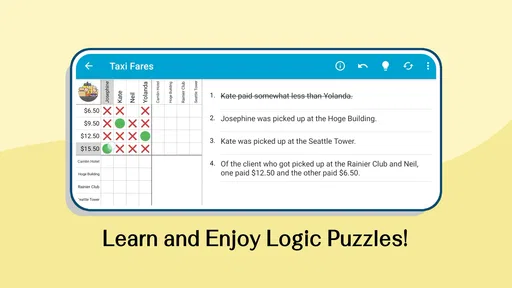
The game belongs to the word-game category, but its real identity is closer to a traditional logic-grid puzzle book adapted for a phone. Each challenge asks me to interpret relationships and use them to narrow down the grid. Instead of guessing vocabulary or racing to recognize a pattern, I have to pay attention to wording, compare clues, and keep track of what has already been ruled out.
That makes the experience naturally self-paced. I can work through a clue immediately, pause when I reach an uncertain deduction, and return later without losing the basic thread of the puzzle. This is important because logic puzzles are not always relaxing when approached as a speed test. Here, the satisfaction comes from building a chain of dependable conclusions.
The store summary describes the game as cross logic puzzles for brain training, and that is a fair description of the core activity. I would not expect a large adventure, character progression, or a narrative campaign. The focus is the puzzle board itself. For me, that narrow focus is a strength when I want concentration, although it may feel limited to anyone who needs constant variety or a strong visual reward after every move.
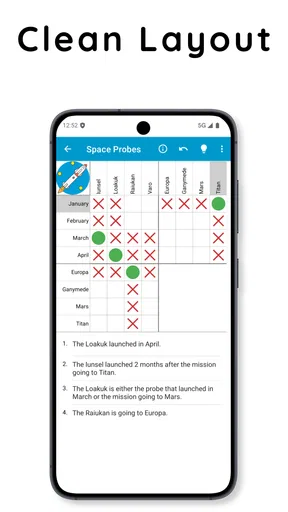
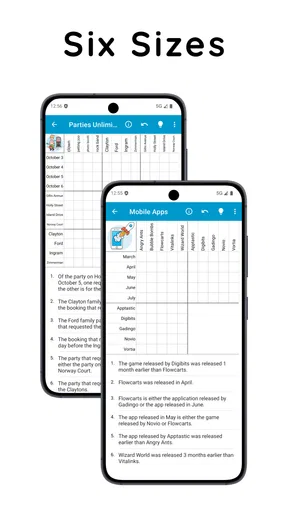
The interface is most useful when treated as a workspace rather than a game board. I read a clue, identify the two categories it connects, then use the grid to record a positive match or eliminate an impossible one. The process rewards careful marking. If I rush and place an assumption as though it were a fact, I can create confusion several steps later. My practical advice is to distinguish direct information from deductions that depend on earlier conclusions.
A better way to approach difficult clues
One of the most useful habits is to begin with clues that give a definite relationship. If a clue clearly pairs one item with another, I use that information first and then inspect the remaining row and column for automatic exclusions. This is more efficient than jumping randomly between clues. Once a category has only one possible match left, that conclusion can often unlock several other cells.
I also recommend reading every clue twice before acting on it. Logic-grid wording can be deceptively compact. A phrase that sounds like a direct match may instead describe an ordering, a location, or a relationship between categories. The game becomes much less frustrating when I treat the language as evidence and avoid filling a square simply because it seems plausible.
A second useful technique is to keep a mental separation between “must be true” and “could be true.” When I am uncertain, I leave the possibility open rather than forcing a decision. That prevents a single weak guess from contaminating the rest of the grid. This is one of the reasons the game can feel like genuine reasoning practice: it rewards managing uncertainty, not just spotting an answer.
For a short session, I choose a puzzle where I can make several early deductions. For a longer session, I am more comfortable taking on a denser set of clues and stopping halfway. The game works particularly well in these small intervals because a puzzle can be treated as a complete mental task instead of an endless feed.
Who will get the most from it
I would recommend it to people who enjoy crossword-style thinking but want more structure than vocabulary recall. It is also a good fit for fans of classic paper logic puzzles who want a portable format. Students may find the elimination process useful for practicing careful reading and organized reasoning, although I would treat it as an informal exercise rather than a formal learning tool.
It can also work for families, provided everyone is comfortable sharing a screen and discussing clues. Solving together changes the experience: one person can read the clue, another can suggest an implication, and a third can check whether the deduction is actually supported. That collaborative use is more interesting than simply handing the phone to someone and asking them to finish a puzzle.
On the other hand, I would skip it if I mainly want quick reactions, colorful action, or a reward loop based on collecting items. It is not the right choice for someone who dislikes reading carefully or becomes annoyed when a puzzle requires several connected deductions. The game asks for patience, and no amount of tapping can replace that.
What the store facts say about its present state
The game is free to install and carries an Everyone age rating, which makes it easy to recommend as a low-risk trial for a broad audience. It has reached over 100 thousand installs and holds a 4.7 average from around 2.5 thousand ratings, with 217 written reviews. Those figures suggest that the focused puzzle format has found a receptive audience, while the written feedback can help prospective players understand how the experience feels in everyday use.
It is currently listed as version 5.7.4 and supports Android 6.0 or later. The version detail matters for two reasons. First, it indicates that this is not an untouched launch build. Second, people using an older phone should check compatibility before planning to play. I would not treat the version number alone as proof of a particular feature or improvement, but it does show that the app has moved beyond its original release state.
The game was released on June 9, 2023, and the current build is the one I would judge when deciding whether to install it today. That distinction is useful because an early impression may no longer describe the present experience. At the same time, a newer version does not automatically mean that every personal annoyance has disappeared. My advice is to focus on whether the current puzzle flow suits you, rather than assuming that its age or update history guarantees a certain style of support.
How the version history affects existing players
For someone already playing, a current build such as 5.7.4 is mainly reassuring because it provides a clear reference point when troubleshooting or comparing experiences across devices. If an older installation behaves differently, updating before judging the game is sensible. It also avoids drawing conclusions from screenshots or descriptions that may reflect an earlier stage of development.
Still, I would keep expectations realistic. The confirmed version and release information establish the product’s current position, but they do not promise a particular future direction. I would not install it expecting a dramatic redesign, a new competitive mode, or a major change in puzzle philosophy unless the developer announces one. The safest expectation is continuity: a deduction-focused game whose value remains tied to the quality and clarity of its puzzles.
That continuity is helpful for returning users. A logic game benefits from familiar rules because the challenge should come from the clues, not from relearning the controls after every update. If I had already built a comfortable solving routine, I would prefer improvements that make the board clearer or the interaction smoother without changing the basic reasoning process.
Where the experience can become frustrating
The biggest limitation is inherent to the format: a difficult puzzle can stop feeling relaxing when I cannot identify which clue should be used next. Unlike a word scramble, there is no satisfying benefit to pressing random answers. The game is strongest for players who accept that progress may be incremental. If I want immediate feedback on every move, a more casual matching game would probably suit me better.
Another possible friction point is screen size. Logic grids contain relationships that are easy to understand on paper, but a phone display gives me less room to see the whole structure at once. On a smaller device, I may need more deliberate scrolling or closer inspection, which interrupts the overview that makes paper grids comfortable. This is not a flaw unique to this title, but it matters when choosing between a mobile version and a physical puzzle book.
The free model also deserves a practical look. In-app purchases range from $2.99 to $4.99 per item. I would begin with the free experience and decide later whether the extra value justifies spending. That approach is especially sensible for occasional players, because the core appeal can be understood quickly. People who solve logic puzzles frequently may view optional purchases differently, but they should still consider how often they will actually open the game before paying.
Because the game is centered on deduction, it may also feel repetitive to players who need a broad mix of mechanics. The theme, clue structure, and grid-solving routine are the point, not a temporary section of a larger package. I appreciate that focus, but I would not call it an all-purpose brain-game collection. Someone looking for arithmetic, memory exercises, trivia, and word searches in one place should choose a broader alternative.
How it compares with familiar alternatives
Compared with a crossword, this game asks less about vocabulary and more about relationships. A crossword rewards recalling words, recognizing definitions, and fitting letters into a pattern. Here, a clue may be easy to understand on its own, but the challenge comes from combining it with other clues. I prefer this format when I want a puzzle that can be solved through organized elimination rather than a large vocabulary.
Compared with a paper logic-puzzle book, the phone version is more convenient but less spacious. I can carry it anywhere and avoid using a pencil, yet a physical grid may be easier to scan when several categories are visible at once. Paper also feels better for people who enjoy making large annotations. The app is the better choice for portability; the book may be better for a long, uninterrupted solving session at a desk.
Compared with quick word searches or anagram games, this title is slower and more demanding. Those alternatives are better when I have only a minute and want a nearly continuous stream of small successes. Logic Grid Puzzles: Brain Game is better when I want one coherent problem that rewards planning. Choosing between them depends less on which game is “best” and more on whether I want speed or deduction at that moment.
A realistic everyday session
Imagine I have fifteen quiet minutes before an appointment. I open the game, choose a puzzle, and start by scanning for the most definite clue rather than trying to solve the whole board. I mark the direct relationship, eliminate the impossible pairings that follow, and then look for a category with only one remaining option. If I reach a point where two possibilities still look equal, I stop instead of guessing.
That stopping point is important. I can put the phone away with the puzzle unfinished and return later, often seeing the wording more clearly after a break. This makes the game a better fit for fragmented free time than many story-based games, where forgetting the previous context can be costly. The mental state is closer to leaving a crossword on the kitchen table than to interrupting a live match.
For a shared session, I would read the clues aloud and ask another person to explain why a mark belongs in the grid. Requiring an explanation exposes weak assumptions quickly. It also turns the game into a small conversation exercise, because two people may interpret a clue differently before checking the surrounding evidence. That is a more valuable use than simply racing to enter the final answer.
What I would like to see watched over time
For future updates, I would pay attention to how clearly the game communicates mistakes and uncertainty. In a deduction puzzle, feedback should help me understand my reasoning without making the solution feel automatic. I would also watch whether the puzzle selection continues to offer a satisfying range of difficulty, since experienced players need challenges while newcomers need a gentle way to learn the method.
I would not assume that every update will change the game dramatically. The most meaningful progress for this type of app can be subtle: clearer interaction, more comfortable grid handling, better pacing, or a smoother return to an unfinished puzzle. Those details affect whether I keep using it after the first few sessions, even though they are less visible than a new headline feature.
Existing users should therefore judge future versions by practical solving comfort rather than by version numbers alone. New players should do the opposite of chasing every update announcement: install the current version, test whether the clue-and-grid method feels natural, and decide based on that experience. The game’s identity is already clear enough that its long-term value will depend on execution more than novelty.
My recommendation
Logic Grid Puzzles: Brain Game is a focused, thoughtful word game that I would recommend to anyone who enjoys deduction and does not need constant animation or competition. Its free entry point, Everyone rating, broad Android compatibility, and strong 4.7 average make it approachable, while the puzzle structure gives it more depth than a quick guessing game. Egghead Games LLC has kept the product centered on a clear idea: use clues carefully, eliminate what cannot be true, and let the answer emerge.
I would choose it for quiet breaks, deliberate solo play, or a shared solving session with someone who enjoys explaining their reasoning. I would avoid it if I wanted a varied brain-training suite, instant rewards, or a generous visual overview that only a large screen can provide. The in-app purchase range of $2.99 to $4.99 per item is worth considering only after I know that the basic routine has become part of my regular play.
My final view is positive but specific. This is not a game I open for excitement; I open it to concentrate. When the clues click together, the payoff is satisfying because I can trace the solution back through the evidence. When I am tired or impatient, the same careful structure can feel demanding. If you enjoy solving one logical problem properly instead of juggling many shallow distractions, this is a strong free game to try.
Verdict
Strengths of Logic Grid Puzzles: Brain Game
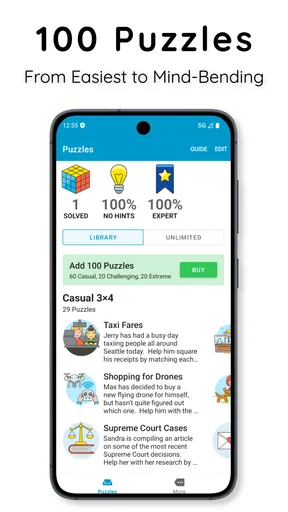
- Hundreds of deduction puzzles provide plenty of content for regular play.
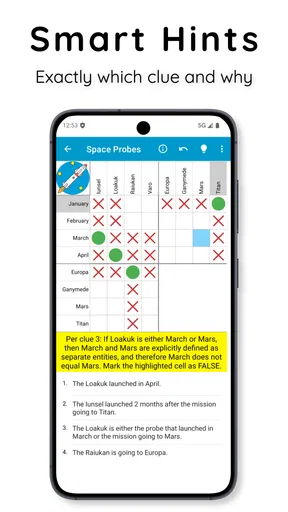
- Helpful clues make difficult puzzles approachable without giving away the full answer.
- Clean interface keeps notes, clues, and grid information easy to follow.
- Works well for short sessions during commutes or quiet breaks.
- Improves attention to detail and logical reasoning through structured challenges.
Limitations of Logic Grid Puzzles: Brain Game
- Some puzzles may feel repetitive once you become familiar with the format.
- Higher difficulty levels can be frustrating without using hints or solving aids.
- Small grid elements may be uncomfortable on phones with compact screens.
- Progress can feel slow if you prefer fast-paced games or instant rewards.
- Some features or puzzle packs may require in-app purchases or contain ads.
Other Releases by Egghead Games LLC
View All
Acrostic Crossword Puzzles
Word4.3
Similar Picks in This Category
View All
Word Search - Word Puzzle Game
Bluetile4.8

Word Search Quest - Puzzles
Blackout Lab4.8

CodyCross: Crossword Puzzles
Fanatee, Inc.4.7

Words of Wonders: Crossword
Fugo Games4.9

Wordscapes: Word puzzle game
PeopleFun4.7

Word Search Explorer
PlaySimple Games4.9
Frequently Asked Questions
What is Logic Grid Puzzles: Brain Game?
Logic Grid Puzzles: Brain Game is a deduction-based puzzle app built around classic logic-grid challenges. Each puzzle gives you a set of clues and several categories, such as people, places, dates, or objects. You must compare the clues, mark possible and impossible combinations, and gradually identify the correct solution. It is designed for players who enjoy careful reasoning rather than fast reflexes.
How does the gameplay work, and is it suitable for beginners?
The gameplay is based on reading clues and filling in a logic grid using symbols or notes to track relationships. Beginners can start with simpler puzzles and learn by eliminating incorrect possibilities step by step. The app is generally approachable because the rules are easy to understand, although more advanced puzzles require patience, concentration, and the ability to combine several clues instead of relying on guesswork.
Does Logic Grid Puzzles: Brain Game work offline?
Many logic puzzle apps allow at least part of their content to be played without an internet connection, which is useful during travel or when mobile data is limited. However, availability of offline puzzles, advertisements, synchronization, and certain online features can depend on the current version of the app and your device. It is worth checking the store description after installation if offline access is especially important to you.
Is Logic Grid Puzzles: Brain Game free to download and play?
The application may be available as a free download, but free access can include advertising, optional purchases, locked puzzle packs, or other limitations depending on the platform and version. Before downloading, review the Google Play Store or App Store listing for current pricing and in-app purchase information. Players who want uninterrupted sessions should also check whether the app offers an ad-removal or premium option.
Can this game improve logical thinking, and who is it best for?
Logic Grid Puzzles: Brain Game can provide useful practice in deduction, attention to detail, reading comprehension, and systematic problem-solving. It is a good choice for casual players, puzzle enthusiasts, students, and adults who prefer quiet, mentally engaging gameplay. It is not primarily an action game, so users looking for rapid challenges, competitive multiplayer, or highly visual entertainment may find its deliberate pace less appealing.
Play our best games!


